
Technology in Education
It’s no surprise that technology is changing everything—the ways we drive, work, and even how we communicate.
It makes sense, then, that technology is also changing the way we learn and teach. And while some changes in technology education are welcomed, like using computers to submit assignments, others are adopted with hesitation—like generative AI. To learn more about integrating technology into education, I sat down with Dr. Christian Penny, an education professor at Westchester University (WCU) in Pennsylvania.
Conversation with Dr. Penny
Originally from the U.K., Dr. Penny came to the states with an interest in education. During grad school, he started using more technology (at the time PowerPoint was the latest and greatest) and realized how much more he could do with tech tools. He became interested in technology, “not for technology’s sake, but [in] how [it] can really help in the teaching and the learning process.”
At WCU, Dr. Penny’s teaching is focused on how teachers can utilize tech to become the best they can be. A lot of technology that comes out isn’t necessarily helpful, he says: “I want my students to be critical consumers of tech…I want them to be makers and creators…[the] active kind of learners.” With tools constantly evolving and AI expanding, Dr. Penny says it’s important to “ask the right questions,” to ask, “if we’re doing this, what are we giving up?”
He finds generative AI fascinating. “There’s a ton of headlines and negative press about generative AI tools, but I think it’s exciting.” He says it keeps him on his toes.
Dr. Penny at Fluxspace and SmartFlower Event
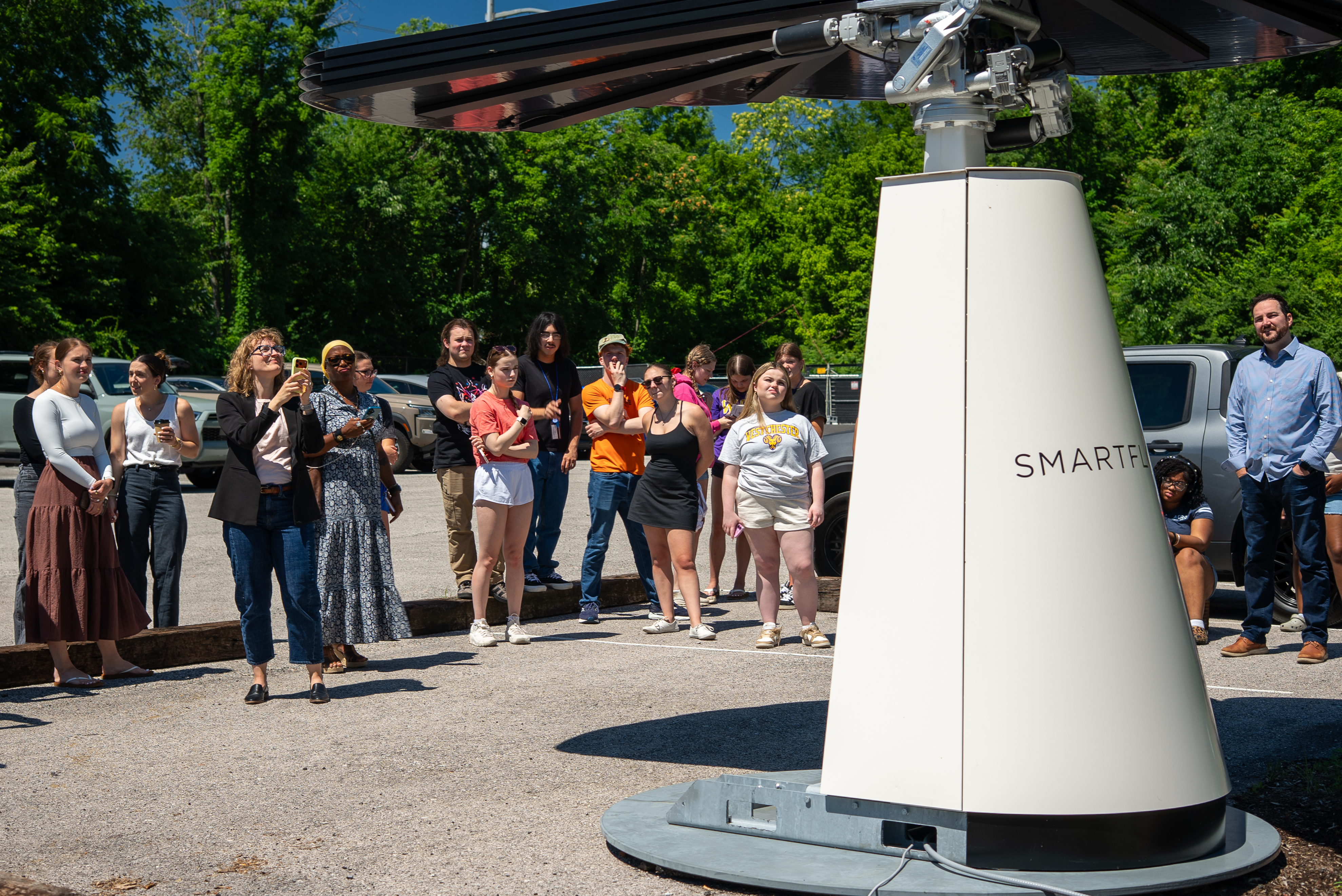
Dr. Penny recently attended the Fluxspace and SmartFlower “Living Laboratory” event that showcased experiential learning tools, including a SmartFlower demo. Fluxspace, which is essentially a huge makerspace, is run by a former student of his, Ryne Anthony.
Dr. Penny is part of summer initiative that partners with school districts in the area and encourages incoming high school seniors to think about teaching careers. For a week each summer, selected seniors are hosted at WCU and take a course about tech and education integration. Dr. Penny brought these students to the event, too.
After watching the SmartFlower, Dr. Penny says he wants the students “to be in awe of the power of all these incredible technolog[ies] that are around them.” He wants them to see how quickly technology innovations are transforming, and encourage them to be lifelong learners as teachers, because things are always changing.
Penny says not everybody thinks this change is an exciting thing, “but…would love for [the] teachers who graduate from Westchester University to be open to this lifelong learning piece and committed to continuing to be the best teacher that they can be using the best tools that are available to them.”
At the culmination of the program, students do some reflective writing, and a lot of students mentioned this trip to Fluxspace as inspirational. Dr. Penny is glad he took them there and gave them “a little glimpse of what’s possible.”
Innovation, Education, and Technology
By adopting tools like the SmartFlower and other experiential technologies at Fluxspace, teachers can embrace innovation in education while preparing their students to become life-long learners and critical thinkers.
To learn more about the Fluxspace and SmartFlower event, read our blog here: A Living Laboratory: How SmartFlower and Fluxspace are bringing hands-on innovation into STEM classrooms – SmartFlower.


